The Boston Arabic Music Ensemble’s Performance (BAME) at CAAP’s Threads of Giving Gala
At our seventh-annual gala, the Center for Arab American Philanthropy (CAAP) will feature a beautiful concert of classic and folkloric Arabic music by the Boston Arabic Music Ensemble (BAME). Continue reading to learn more about the talented artists joining us tonight and the significance of each piece performed.
***To support young musicians’ journeys, please consider giving to the Cultural Dialogue for the Arts Fund at CAAP. Your donation will provide scholarships for talented young people pursuing their education in music. Give here.
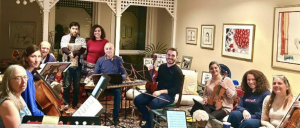
Tonight, we are joined by:
Bengisu Gökçe (BAME – Music Director)
Alejandro Castellano (BAME – Guitar/Oud/Percussion)
Antonius Chedid (BAME – Violin)
Ghaleb Daouk (BAME – Nay/Flute)
Rania El-Fekih (BAME – Voice)
Layan Hawila (BAME – Oud/voice)
Alyssa Lawson (BAME – Cello)
Jamal Sinno (Guest Artist)
Fabio Pirozzolo (Guest Artist)
Performance Details
Taqaseem on Qanoun | Jamal Sinno
This form of improvisation is typical of classical Arabic music, often played solo or within a composition. It is meant to bring about the sense of musical ecstasy, known as “saltana” and get the singer or listeners in the mode (scale) of the song or music to follow. It also showcases the virtuosity of the performer and their mastery of the instrument at hand.
Samai’ Bayati | Ibrahim Al-Aryan
Sama’is in general, and this one in particular, have a defined structure with sections called “khane” and “tasleem”. The “tasleem” is a recurring refrain or melodic pattern, while the “khane” represents melodic development. Ibrahim Al-Aryan was a prominent Egyptian musician, known for his work as a Qanoun player in Umm Kulthum’s band and for his own compositions. The piece is based on Maqam Bayati, a melodic mode common in Arabic music, and it also modulates to Maqam Rast in the second “khane”
Sa’alouni Al-nass| Ziad Rahbani/Fayrouz
The early beginnings of the late Ziad Rahbani composition and the first song he wrote at the age of 18, dedicated to his mother Fayrouz in 1973, but first sound in public by him as she was taken ill that concert day. It is in the popular maqam bayati part of his album “bil afrah”.
Emta ha te3raf | Mohamed Qasabgi
Famously sung by the renowned singer Egyptian/Syrian Asmahan, and composed by one of the most respected Egyptian composers of the early-mid 20th Century, Mohamed Qasabgi, long time composer for famous singers mostly the diva Um Kulthum, this song’s title means “when will you know” (that I love you). It illustrates the versatility of the Arabic musical maqam scales,as it moves back and forth from the nahawand, to Bayati, before it gets into the ajam, and finishes in the nahawand where it started, a variation that is at the heart of tarab, bringing out the musical skills of the composers and melodious interpretation of the vocalist.
Olive Harvest | Simon Shaheen
A lively dance-like instrumental piece describing a scene from the Olive harvest in Palestine/Lebanon/Syria that typically occurs in the fall season, with many family members, friends and workers pulling together their effort in picking olives in a collective joy. It is dedicated to world peace.
Lamouni | Hedi Jouini/ El-Fekih
A Tunisian folk song, Lamouni Ligharou meni (translation: I was blamed by those who envied me) is well known throughout North Africa, performed by many including Jewish singers who lived together with the Arabs in North Africa, after centuries of cohabitation in Andalusia. Composed by the famous Tunisian music and song writer Hedi Jouini (b 1909 Tunis) in the maqam nahawand and performed by famous singers, likely first by Jalel Benna in the early 1930s.
Billathi askara | Traditional/Rahbani
One of the most famous of muwashahat (plural of muwashah), a classic poems sung that proliferated in Andalousia, and known for its beautiful lyrics and melody. It is performed in several middle eastern countries and in different languages and variations on the original maqam Bayati. One of the most listened to is the arrangement by the Rahbani brothers and sung by Fayrouz, that we perform tonight.
Ah Ya Helou | Traditional/Syria
“Ah Ya Helou” (or “Ah Ya Hilew”) is a popular Arabic song, likely a traditional Syrian folk song, meaning “Oh Beautiful One” or “Oh Sweetheart”. It has been recorded by various artists, including Mouhammad Kheyri, Hanan, and Zein Al-Jundi. The song is known for its lyrical content and is often performed in a traditional style.
Qudud |Traditional Iraq-Syria
A Medley of popular small Arabic songs referred to as qudud (plural of qud, a popular song) mostly in the maqam hijaz. The final of the songs, qadduki al mayyas made famous by the Syrian renowned qudud performer Sabah Fakhri.
Nassam Alaina al-Hawa |Rahbani brothers
Popular song composed and written by the Rahbani brothers, Assi and Mansour, and made popular by the famous Lebanese contralto singer Fairuz, known as “voice of Lebanon” who first performed it in the 1968 film “Bint el Haress” where she was the lead actress as well.Nassam, meaning a breeze, and Hawa has a double sense in Arabic, as wind and also love, has been interpreted as an expression of longing of diasporic Arab communities for the homelands.
Program notes compiled and written by Ghaleb Daouk